Designing Injection Molds for Electronic Enclosures: Key Requirements and Considerations


The design and manufacture of electronic enclosures is necessary for contemporary electronics so as to ensure better performance, aesthetics and also durability. Such special enclosures not only help in safeguarding the delicate internal parts of the equipment from unfavorable environmental conditions such as moisture, dust, and mechanical abuse but they also offer uniqueness and reliability to the user’s interface. It is therefore very important that every electronic enclosure integrates good design and performance while meeting the required standards for quality manufacturing. These enclosures are made through the use of injection molding processes which allow for the quick and economical production of highly uniform and precise parts. Any injection molded enclosure depends largely on the success of the injection molding process and as such requires proper design and other considerations. This article will provide useful information to engineers and designers in order to improve their manufacturing approaches by analysing key considerations and requirements for the design of injection molds for electronic enclosures.
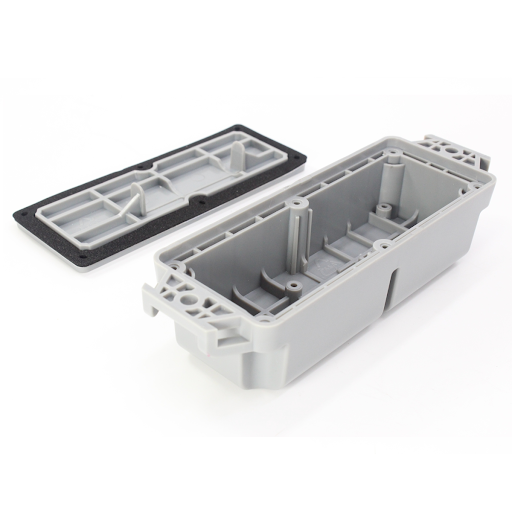
Challenges in Designing Electronic Enclosures
Modern electronics have created a set of very demanding requirements which present some unique challenges when designing electronic enclosures. To protect sensitive internal components from environmental factors (such as moisture, dust and physical impact), enclosures must be able to protect these surrounding components. In addition, they also have to overcome risks of electrostatic discharge (ESD), which can damage electronic circuits. Proper cooling is another critical consideration due to overheating and/or reduced performance as a result of improper cooling can result in further overheating, component failure or poor performance. Other enclosures must have the right impact resistance as well, to ensure that the devices will still work fine even with rough handling or accidental drops.
The injection molding tool design for these enclosures is quite intricate as it is needed to cater for variegated requirements and still deliver on precision and material requirements. The design of the mold involves specific tolerances, which prevents problems such as components, clips ports or mounting holes interference fit. On the other hand, the material properties should combine strength, thermal stability, electrical insulation, and molding friendly. At the same time, the injection molding process must deliver the right measurements while preventing distortions or inferior surface smoothness, further increasing the task’s complexity.
Key Requirement: Material Selection
One of the most important aspects when designing electronic enclosures is the selection of suitable materials. This is because it determines the functionality, life span, and safety of the finished product. Acrylonitrile Butadiene Styrene, Polycarbonate, acrylic and other materials like polyester and nylon are commonly used in the making of these enclosures. This is particularly true of ABS, which is selected due to its low cost, relative ease of molding and good impact resistance for a wide range of consumer electronics. Polycarbonate has greater strength and clarity which makes it useful for making transparent components and when great toughness to impact is required as well. Acrylic is used more frequently because of its clarity as well as its aesthetic appeal, but does not have the strength of ABS and PC.
In order for the enclosure to perform as intended, the key material properties must be taken into consideration. For example mechanical strength to withstand impacts, electrical insulation to prevent sensitive parts from contact, heat resistance to restrain from excessive heat, UV protection to avoid damage from the sun, and flame retardant to secure it safely in extreme conditions.
Furthermore, mold flow requirements during injection molding and the material’s flow characteristics including the melt flow rate and the cooling shrinkage ratio must be considered during mold design.
Heat Management and Cooling Design
An aspect of electronic enclosure design that needs proper attention is associated with the transfer of heat from the enclosure because high temperature can damage electronic components and also lower their reliability. Enclosures should be able to release heat to avoid interior parts from malfunctioning. Considerations include thermal characteristics of the materials and the combined heat dissipation capability of the overall component. Poor heat management can result in thermal buildup which can result in poor performance of a component, short lifespan and can ultimately cause the component to fail.
Typical cooling design methods include using a heat sink to allow heat to be driven away from critical components and to optimise thermal flow. An alternative is to place cooling channels within an enclosure with a very careful layout, directing flow around areas that are heat sensitive to enhance heat dissipation. Furthermore, incorporating thermal conductive materials such as aluminium or thermally enhanced plastics may help to boost the enclosure’s overall cooling efficiency.
Therefore it is important in injection mold design to work towards the even distribution of heat in the enclosure to avoid hot spots. Hot spots can cause the material to weaken or warp. Uniform cooling can be enhanced in the mold design by strategically placing cooling channels around high temperature regions. Manufacturers can use heat management – both in the design and in the molding process – to ensure integrity and reliability of the electronic enclosure.
Precision and Tolerances in Mold Design
The fabrication processes used when designing electronic enclosures require a great deal of precision. That is because even a small defect would result in functional failure of such enclosures. Clips, interfaces and holes need to be constructed with precision to allow proper assembly, functionality. When constructing such clips to hold down circuit boards or connectors, be sure to pay particular attention to getting these to fit properly together. Drilling holes for screws or ports must be done so accurately so that misalignment chances and malfunctioning do not occur during assembly.
Achieving precise dimensions and smooth surfaces, however, depends on the plastic injection molding parts. First, depending on what features are needed on the final enclosure, the tolerance of each feature must be detailed,and the mold cavity must be designed to accommodate those specific tolerances. By molding components with high precision during the injection molding process, parts with good dimensional control and consistent surface finishes are produced, ensuring smooth functionality for clips, connectors and mounting features.
Therefore, careful fine tuning of mold design is required to meet these precision requirements. Accuracy in the final product can be influenced by more factors such as mold material, cooling rates and more on the design of the gating system. If manufacturers optimize these elements, defects can be decreased and quality of product ensured, high quality electronic enclosure can be attained, so that manufacturers can make reliable work and conform to stringent assembly standards.
Conclusion
Designing injection molds for electronic enclosures is an extensive fabrication process, which mainly depends on several key factors: precision, heat management, EMI shielding, and thus material selection, and cost control. If manufacturers take these into account in the design phase, the produced enclosures will be a result of high quality, durable enclosures that meet the industry standards and protect the sensitive components. Close collaboration with mould manufacturers is essential as well as the use of simulation tools to predict potential problems, and rigorous testing to prove feasibility and the resulting optimisation for production design. This proactive approach avoids costly delays and provides high performance enclosures.


